Medical Marijuana is No Laughing Matter for Those Who Need it

Follow by Email
Facebook
Facebook
Twitter

ARLINGTON — When we hear about states legalizing medical marijuana, it’s easy to picture situations like this. But for folks like Eric Espinoza, who suffers from spastic cerebral palsy, the need for daily medication is no laughing matter.

“You take 1 to3 a day of various things,” Espinoza told NewsFix. “Muscle relaxers, painkillers, anti-inflammatories.”

He’s even spent time taking more extreme medications.

“It’s a year of my life I’ll never get back because there is no memory on Oxycontin.”

Espinoza says his search for a better option led him to visit Colorado, where he - and others like him - have experimented with medical cannabis.

“They’re not looking for a good time,” said Espinoza. “They’re looking for 48-72 hours of relief. I was enjoying my environment and my surroundings, I was not thinking about my condition. And it’s not something that I worry about ‘if I accidentally take another pill, am I gonna die?’

“It’s difficult in Texas to talk about medical cannabis with your doctor. ‘Well, I can’t give that to you because you would just be at a Whataburger drive-thru with the munchies at midnight,'” he said mocking how a doctor might respond.

Hey, the doctors couldn’t prescribe marijuana anyway, since it’s against the law here. But with more than half the country now giving the stuff a green light, who knows what will happen in the future.

In the meantime, Eric says “I’m a patient, not a criminal.”


Source: CW33


Follow by Email
Facebook
Facebook
Twitter

Farmer Tom and the federal agents on his farm

Follow by Email
Facebook
Facebook
Twitter

FARMER TOM

Revolutionizing Cannabis, One Fed A Time


20151029pbp_Farmer-Tom_5373

Photo: Patricia Bennett


When federal agents visit a pot farm, it’s not by invitation—but it was this time.

Tom Lauerman, affectionately known as Farmer Tom, invited federal researchers to spend several days at his organic hippie grass-land (medical cannabis farm) in Vancouver, Washington to evaluate cannabis processing procedures. It was the first and only known time the feds have conducted friendly business on a privately owned pot farm. This is a big deal: the only federally approved cannabis research facility was established at the University of Mississippi in 1968.

Late in October 2015, four agents of the CDC’s National Institute for Occupational Safety and Health (NIOSH) made their way to the pot farm’s “secure location,” according to the official documents—a point that gave Farmer Tom a chuckle. Also present was T.J. Lauritsen from the United Food and Commercial Workers International Union (UFCW). Together, they were establishing safety standards and best practices for medical cannabis and cannabis workers by conducting a Health Hazard Evaluation (HHE).

Lauritsen said he selected Farmer Tom’s for the HHE after collaborating with him on some worker training materials. The union thought his small organic farm would be a good baseline entry for the feds to become familiar with the product and not overwhelm them with a large warehouse grow.

“I never thought in my life that by the time I turned 55, we would have federal agents welcomed onto my farm—asking to come to my farm—and I’d get to educate them about cannabis. It simply just blows my mind,” said Farmer Tom.

It is surprising, given the federal government’s official stance on cannabis, a “most dangerous” weed.

Farmer Tom Plants
Farmer Tom Plants

How It All Went Down

“TJ was telling me these things take a long time, but we started the conversation in May [2015] and in June we had our first phone call,” said Farmer Tom.

The call revealed that the CDC agents “knew nothing” about cannabis. Farmer Tom invited them to the farm to introduce them to the community so they’d know what to expect from the proposed evaluation. That first trip was in August 2015.

Everyone got along great, he said. They even went out for beers together. “They looked on as we smoked weed throughout the day and saw that we were fully functional and engaged.”

As farm workers and federal agents got to know one another, the mood relaxed. Folks would hang out and chat in the outdoor kitchen, just a few steps from a charming art collection and a display of the season’s myriad squash varieties. This working farm grows cannabis, but it’s just one of several crops. Ever present and holding the show together was Farmer Tom’s wife and partner, Paula.

NIOSH agents outfitted Farmer Tom and a few others in “sniffer” vests that measured the air quality surrounding the workers. The air quality inside the processing greenhouse was also measured for comparison to the ambient air of the farm.

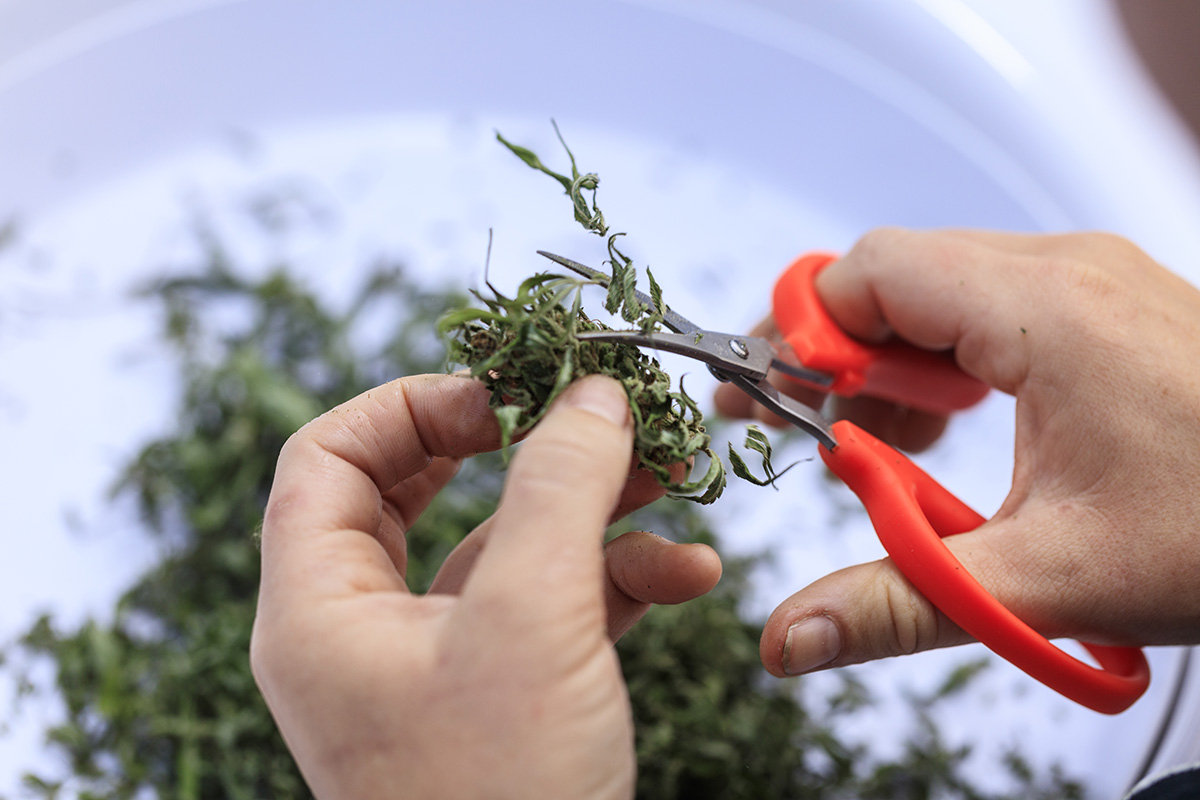
As workers trimmed bud, they wore a specialized glove with sensors to measure frequency of movement, analyzing for potential repetitive motion issues. Various surfaces were swabbed looking for potential contaminants, such as molds and other allergens. Results are expected to take nearly a year.

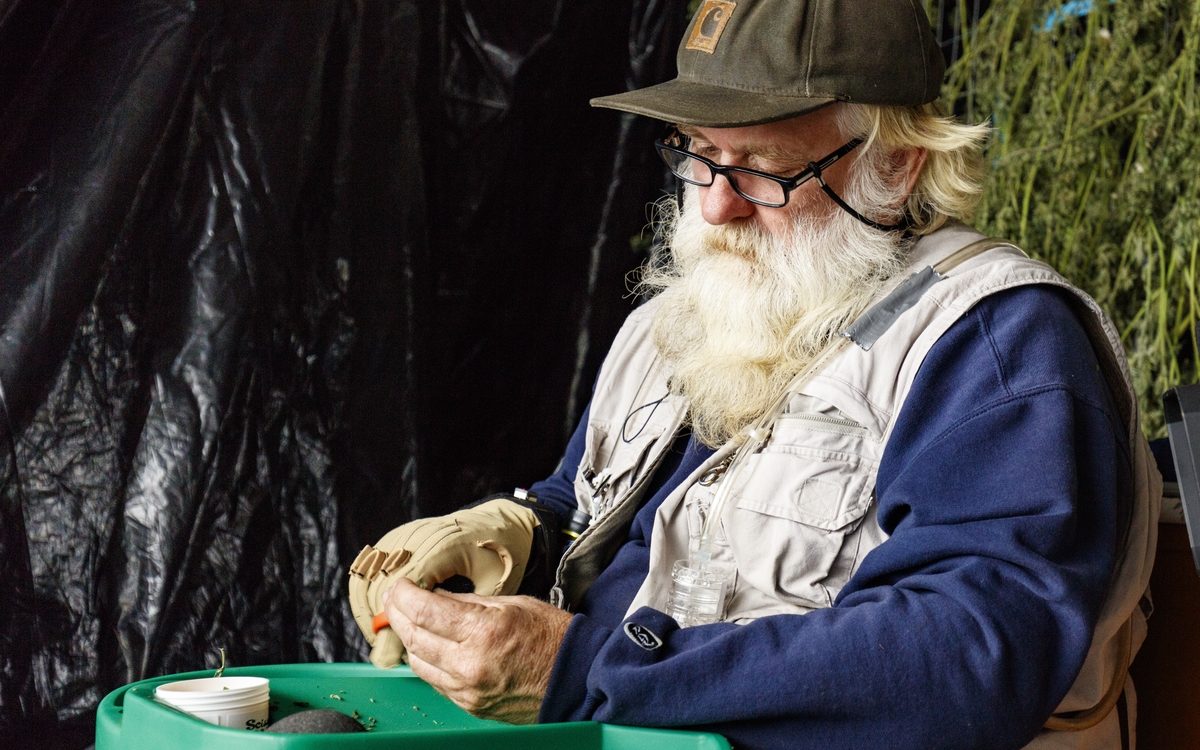
Farmer Tom Trimming
Investigators determine a baseline of the time it takes a professional trimmer by timing and weighing the resultant product as part of the Health Hazard Evaluation by NIOSH.

How Federal Agents Can Visit A Cannabis Farm

Cannabis is still federally registered as a Schedule I narcotic, among the most dangerous. The qualification means that there is no currently accepted medical use and a high potential for abuse.

“For us, it’s because it’s a legal workspace in the state of Washington,” said NIOSH spokesperson Christy Spring. “We received a valid legal request from a legal employer. So it’s not a matter of judging whether or not the product being manufactured is legal as much as the fact that under the state law this is a legal workplace. Our interest is the occupational health and safety aspect of it. There has been a lot of curiosity, but we’ve heard no criticism.”

“The HHE process is initiated by a request for safety guidelines from employers, employees, or unions,” said lead field investigator James Couch. “NIOSH can either point them to existing information for their occupations or choose to do a new evaluation. In this case, cannabis is fairly new, especially in the occupational health world. There’s really nothing out there.” Farmer Tom’s request was considered to be a “novel” workplace exposure, ripe for an HHE.

Indeed, Couch conducted a literature review and found no other information from any other federal agency looking into the cannabis industry.

Speaking with Couch, it’s easy to see the value of the HHE program. There just aren’t a lot of research groups with a rapid response that’s capable of getting ahead of these emerging occupational hazards and getting out into the field to look at real-time exposures.

Even in the world of legalized cannabis, Farmer Tom is a pioneer. There isn’t many organic small farm grows. The majority of farmers use pesticides and harmful chemicals, but Farmer Tom is setting the bar higher for the entire industry.

“I think it’s all about baby steps,” he said. “My position on this is just to normalize cannabis. Any way you can get the feds out here—if you can get them out here—is a huge step.”

By: Patricia Bennett

Source: http://www.dopemagazine.com/farmer-tom/

Follow by Email
Facebook
Facebook
Twitter

Report: NFL owners ‘privately support’ marijuana as pain management alternative

Follow by Email
Facebook
Facebook
Twitter
Are NFL owners beginning to read the writing on the walls all around them?

On the heels of two more states where NFL teams are housed, California and Massachusetts, approving marijuana for recreational use, it seems that there’s a growing consensus around the league that players should be able to use the drug as an alternative for painkillers.

It was reported on Wednesday that the NFLPA will conduct studies to see if marijuana itself is a viable alternative for players to use instead of painkillers. It’s the first time that the union has publicly talked about the possibility (more on that here).

It now looks like some owners might be falling in line here.

“Several NFL owners said privately that they would support a more open approach to the use of marijuana as a means of pain management for players,” Bleacher Report’s Jason Cole reported Thursday. “

The idea here, at least according to Cole, is that marijuana could be used as an alternative to more harmful painkillers. This is something that’s come to the forefront in recent years around the NFL, especially when the league itself is falling behind the broader American society when it comes to the perception of marijuana use.

Tuesday’s election results brings the number of teams playing in states where marijuana is legal for recreational use to seven. That’s nearly one quarter of the league.

This can cause somewhat of a double standard between the use of the drug for the general population and the players on a quarter of the league’s teams.

Of course, any change in the NFL’s substance abuse policy would have to be brought forth under the guise of the collective bargaining agreement. It’s in this that owners showing themselves to be more open could be a huge step in the right direction.

Written by Vincent Frank

Source: http://sportsnaut.com/2016/11/report-nfl-owners-privately-support-marijuana-as-pain-management-alternative/

Follow by Email
Facebook
Facebook
Twitter

Marijuana Wins Big on Election Night

Follow by Email
Facebook
Facebook
Twitter

California, Massachusetts, Maine and Nevada Legalize Marijuana, As Florida, Arkansas, Montana and North Dakota Approve Medical Marijuana Measures

TELECONFERENCE Tomorrow (Wednesday) at 12:30pm (ET) / 9:30am (PT): What Do Election Results Mean for Marijuana Law Reform?

This Election Day was a watershed moment for the movement to end marijuana prohibition, with the results expected to accelerate efforts to legalize marijuana in states across the U.S., at the federal level, and internationally. Overall, legalization initiatives prevailed in four out of five states, and medical marijuana initiatives prevailed in all four states this year.

Votes are still being counted for legalization initiatives in Maine and Arizona, as well as for a medical marijuana measure in Montana to improve the state’s existing medical marijuana law. Maine and Montana look headed for victory and Arizona for defeat. If those results hold, legalization initiatives will have prevailed in four out of five states, and medical marijuana initiatives will have prevailed in all four states this year.

“Marijuana reform won big across America on Election Day – indeed it’s safe to say that no other reform was approved by so many citizens on so many ballots this year,” said Ethan Nadelmann, executive director of the Drug Policy Alliance. “But the prospect of Donald Trump as our next president concerns me deeply. His most likely appointees to senior law enforcement positions – Rudy Giuliani and Chris Christie – are no friends of marijuana reform, nor is his vice president.”

“The momentum for ending marijuana prohibition took a great leap forward with the victories in California and elsewhere, but the federal government retains the power to hobble much of what we’ve accomplished. The progress we’ve made, and the values that underlie our struggle – freedom, compassion, reason and justice – will be very much at risk when Donald Trump enters the White House.”

The most significant victory was California’s Proposition 64, which legalizes the adult use of marijuana and enacts across-the-board retroactive sentencing reform for marijuana offenses, while establishing a comprehensive, strictly-controlled system to tax and regulate businesses to produce and distribute marijuana in a legal market. Experts are calling Prop. 64 the new “gold standard” for marijuana policy because of its cutting edge provisions to undo the most egregious harms of marijuana prohibition on impacted communities of color and the environment as well as its sensible approaches to public health, youth protection, licensing and revenue allocation.

“With its carefully crafted provisions for helping to heal the damage caused by the war on marijuana to poor communities and people of color, Prop 64 represents the new gold standard for how to legalize marijuana responsibly,” said Lynne Lyman, California state director for the Drug Policy Alliance. “This not only protects youth from accessing marijuana products, it also protects them from being harmed by the criminal justice system. Young people can no longer be arrested for marijuana offenses, which data consistently show us is a primary gateway to the criminal justice system. And with hundreds of thousands of residents eligible to have their records cleared, Prop 64 is a major victory for Californians who care about justice.”

By shifting away from counterproductive marijuana arrests and focusing instead on public health, states that have legalized marijuana are diminishing many of the worst harms of the war on drugs, while managing to raise substantial new revenues. A recent Drug Policy Alliance report found that Colorado, Washington, Alaska and Oregon have benefitted from a dramatic decrease in marijuana arrests and convictions, as well as increased tax revenues, since the adult possession of marijuana became legal. At the same time, these states did not experience increases in youth marijuana use or traffic fatalities.

Tuesday’s results also have monumental international ramifications, as momentum grows to end marijuana prohibition in Europe and the Americas. Over the past two years, Jamaica has enacted wide-ranging marijuana decriminalization; Colombia and Puerto Rico issued executive orders legalizing medical marijuana; and medical marijuana initiatives have been debated in Argentina, Brazil, Mexico and Italy. In 2013, Uruguay became the first country in the world to legalize marijuana on a national level, and Canada’s governing Liberal Party has promised to do the same.

Among the highlights of Tuesday’s results:

  • California voters approved Prop 64, which allows adults 21 and older to possess up to an ounce of marijuana and grow up to six plants at home. The initiative also legalizes the industrial cultivation of hemp. The Bureau of Medical Marijuana Regulation will be renamed the Bureau of Marijuana Control, and will oversee 19 different licenses for businesses and cultivation. The initiative does not allow large-scale cultivation for the first five years, so small farmers have an advantage. A 15% excise tax on marijuana sales and a cultivation tax will be used to pay for the regulatory structure. Additional revenue will go toward youth substance abuse prevention, medical marijuana research, environmental protection and remediation, and local governments. The initiative also allocates substantial resources toward economic development and job placement for neighborhoods most in need, and creates a system for sentences to be retroactively reduced and past marijuana convictions to be expunged.The Drug Policy Alliance and its lobbying arm, Drug Policy Action, played a key leadership role in the California campaign — co-drafting the initiative, coordinating the political mobilization, social media, public relations and more, and raising over $5 million to fund the effort.
  • Massachusetts voters approved Question 4, allowing adults 21 and older to possess up to an ounce of marijuana, and grow up to six plants in their home. The initiative establishes a Cannabis Control Commission to oversee the licensing of marijuana retail stores, as well as cultivation, manufacturing, and testing facilities. It enacts a 3.75% excise tax on marijuana sales used to pay for the regulatory structure. Additional revenue will be deposited into Massachusetts’ General Fund. While public consumption of marijuana would not be allowed, if a city or town permits it by vote, this law would allow for the consumption of marijuana on the premises where sold or on a limited basis at special events. The new law provides support for communities disproportionately harmed by the drug war, by requiring the new regulating agency to adopt procedures and policies to promote and encourage full participation in the marijuana industry by people from communities that have previously been disproportionately harmed by marijuana prohibition and enforcement. It also requires the agency to develop policies to positively impact those communities, such as education, job training, and placement programs. The law also states that a prior conviction solely for a marijuana-related offense will not disqualify an individual from being employed in the newly legal marijuana industry or from getting a license to operate a marijuana business, unless the offense involved distribution to a minor.The Drug Policy Alliance and its lobbying arm, Drug Policy Action, supported this initiative with assistance on the drafting, as well as financial support for the campaign.
  • Maine voters approved Question 1, which allows adults 21 and older to possess up to 2 ½ ounces of marijuana, and grow up to six flowering plants and 12 nonflowering plants. The initiative instructs the Department of Agriculture, Conservation and Forestry to regulate and control the cultivation, manufacture, distribution and sale of marijuana. It also provides for the licensure of retail social clubs where marijuana may be sold for consumption on the premises to adults 21 and older. The initiative enacts a 10% excise tax on marijuana sales that will be deposited into Maine’s General Fund. The Drug Policy Alliance’s lobbying arm, Drug Policy Action, supported Maine’s initiative with financial support for signature collection.
  • Nevada voters approved Question 2, allowing adults 21 and older to possess up to an ounce of marijuana. Those who do not live within 25 miles of a retail marijuana store may grow up to six plants in their home. The initiative instructs the Nevada Department of Taxation to oversee the licensing of marijuana retail stores, as well as cultivation, manufacturing, and testing facilities. It also establishes a 15% excise tax on marijuana sales used to fund schools, and the marijuana regulatory structure. The Drug Policy Alliance and its lobbying arm, Drug Policy Action, supported Nevada’s initiative with assistance on the drafting, as well as financial support for the campaign.
  • A marijuana legalization initiative in Arizona was narrowly defeated. The Arizona opposition raised $1 million from Discount Tire Company and another $500,000 from a pharmaceutical firm that produces the powerful synthetic opioid, fentanyl. Their strategy by and large depended on deceptive messaging designed to stoke fears of change.
  • Florida voters approved Amendment 2, legalizing medical marijuana. The initiative instructs the Department of Health to register and regulate centers that produce and distribute marijuana for medical purposes, and issue identification cards to patients and caregivers. Individuals with cancer, epilepsy, glaucoma, HIV, AIDS, PTSD, ALS, Crohn’s disease, Parkinson’s disease, multiple sclerosis, or other debilitating medical conditions as determined by a physician will be able to purchase and use medical marijuana. Florida requires 60% of the vote to pass – a similar initiative in 2014 was defeated despite winning 57.6% of the vote. The Drug Policy Alliance and its lobbying arm, Drug Policy Action, supported this initiative with assistance on the drafting, as well as financial support for the campaign.
  • Arkansas voters approved the Arkansas Medical Marijuana Amendment, Issue 6, will allow seriously ill patients who have a certification from their doctor to obtain medical marijuana from dispensaries. Patients are prohibited from ever cultivating at home. The program is overseen by a new medical marijuana commission and the state’s Alcoholic Beverage Control. Arkansas joins Florida as the first states in the South to approve medical marijuana. DPA’s lobbying arm, Drug Policy Action, provided financial support for the campaign.
  • North Dakota voters approved Measure 5, which legalizes the medical use of marijuana for conditions such as cancer, AIDS, hepatitis C, ALS, glaucoma, and epilepsy, and other debilitating medical conditions. Patients will be permitted to possess up to 3 ounces of marijuana. The initiative instructs the Department of Health to issue ID-cards for qualified patients and regulate non-profit compassion centers which will serve as dispensaries for patients. Individuals living more than 40 miles from a dispensaries will be permitted to grow up to eight plants in their home. DPA’s lobbying arm, Drug Policy Action, provided financial support for the campaign.
  • A Montana medical marijuana measure was approved. In 2004 Montana passed a ballot initiative to allow for the production, possession and use of marijuana by patients with debilitating medical conditions. But the legislature subsequently restricted the medical marijuana law to make it practically unworkable. I-182 would restore Montana’s medical marijuana law to ensure that patients have meaningful access to their medicine. DPA’s lobbying arm, Drug Policy Action, provided financial support for the campaign.

A nationwide Gallup poll released last month found that a record 60 percent of respondents support legalizing marijuana. In 2012, Colorado and Washington became the first two U.S. states – and the first two jurisdictions in the world – to approve ending marijuana prohibition and legally regulating marijuana production, distribution and sales. In the 2014 election, Alaska and Oregon followed suit, while Washington D.C. passed a more limited measure that legalized possession and home cultivation of marijuana (but did not address its taxation and sale due to a federal law passed by Congress in 2014 that bars D.C. from pursuing taxation and regulation). After today’s victories, there are now 28 states with medical marijuana laws, eight of which have also approved legal regulation of marijuana for adults 21 and over.

DPA will hold a teleconference tomorrow (Wednesday) at 12:30pm ET / 9:30am PT to discuss the national implications of today’s votes.

CONTACT:

Tommy McDonald, 510-338-8827, [email protected]
Tony Newman, 646-335-5384, [email protected]

Source: Drug Policy Alliance

Follow by Email
Facebook
Facebook
Twitter

A watershed moment in drug law reform

Follow by Email
Facebook
Facebook
Twitter

November 5 at 11:05 AM

Ignored in the tumult of the presidential race is the fact that the 2016 election may be a milestone in the struggle to end marijuana prohibition. Five states – Arizona, California, Maine, Massachusetts, and Nevada – all have marijuana legalization initiatives on the ballot. Polls indicate that all five are likely to pass, as well as a medical marijuana initiative in Florida. Medical marijuana legalization initiatives in Arkansas and North Dakota seem too closes to call. A recent nationwide Gallup poll finds that a record 60% of Americans support pot legalization.

If these five states all legalize recreational marijuana – adding to the four states that have already taken this step, it would be a major blow to marijuana prohibition nationwide. The California initiative is particularly important, because the state is so big and has such a large population.

Even if all of the legalization referenda pass, marijuana possession will still be illegal under the federal Controlled Substances Act. The constitutionality of sweeping federal marijuana prohibition was upheld in Gonzales v. Raich, the poorly reasoned 2005 Supreme Court decision holding that Congress’ power to regulate interstate commerce allowed it to ban the possession of medical marijuana that had never crossed state lines or been sold in any market. In Raich, constitutional federalism became yet another casualty of the War on Drugs.

But even if federal marijuana prohibition is entirely constitutional and remains on the books, it will be extremely difficult to enforce without the cooperation of state governments. As a practical matter, the federal government has only a very limited supply of law enforcement personnel, and depends heavily on state police and prosecutors for help in waging the War on Drugs. If that assistance is no longer forthcoming in many of the nation’s largest states, it is unlikely that Washington will ramp up its own enforcement efforts enough to compensate – especially since such action might be very unpopular in the affected states. The growing trend towards legalization at the state level might even incentivize Washington to repeal federal marijuana prohibition entirely.

There is an ongoing debate over the effects of marijuana legalization in Colorado, which voted to legalize in 2012. But, so far, there is no evidence of significant negative effects on health, violent crime, or fatalities caused by driving under the influence. Black market marijuana sales persist, but largely because legalization has not gone far enough (high taxes incentivize illegal sales).

CONTENT FROM ALLSTATEWhat do millennials really care about?

A revealing survey of the generation that could swing the vote in this election.

The really big advantage of ending marijuana prohibition is not the possible health benefits, but eliminating the harm caused by the arrest and imprisonment of many thousands of people, many of them poor and disadvantaged. The FBI estimates that some 643,000 people were arrested in for marijuana offenses in 2015, including some 574,000 for mere possession. While only a small minority of these arrests lead to prosecution, the arrests themselves can be traumatic and dangerous, and can end up damaging the educational and employment prospects of those targeted. Arrests also often unavoidably create confrontations in which suspects and police officers could be injured or (in rare cases) killed. Over 12,000 people are incarcerated for marijuana offenses in federal prison. I have not been able to locate good recent data on marijuana-related incarceration in state prisons. But the numbers are likely to be much higher. All of these arrests and incarcerations inflict serious harm on suspects, and expend vast amounts of law enforcement resources that could better be employed combating violent crime.

Whatever else can be said of state-level marijuana legalization, it greatly reduces marijuana-related arrests and incarceration. In Colorado, marijuana possession arrests have declined by 95 percent, and in Washington by 98 percent.

If marijuana legalization does indeed prevail nationwide, it might also stimulate efforts to put an end to the broader War on Drugs, which inflicts massive harm on society far greater than that of marijuana prohibition alone. Standard measures may even somewhat underestimate the large numbers of people incarcerated for drug offenses.

We should not be too confident about the results of Tuesday’s referenda. Six years ago, the last California marijuana legalization initiative failed by a 54-46 margin, after some polls indicated that it might narrowly prevail. But public opinion has shifted since then, and this year’s Proposition 64 enjoys a much larger, double-digit leads in the polls.

If Proposition 64 does pass, it would help vindicate my 2010 predictionthat generational change would ultimately produce a majority in favor of legalization. This may seem obvious in retrospect, and perhaps it should have been obvious back then. But at the time, I had to contend with prominent skeptics who argued that elderly voters and parents would block legalization for the foreseeable future.


——————————————

Ilya Somin is Professor of Law at George Mason University. His research focuses on constitutional law, property law, and popular political participation. He is the author of “The Grasping Hand: Kelo v. City of New London and the Limits of Eminent Domain” and “Democracy and Political Ignorance: Why Smaller Government is Smarter.”

Source: The Washington Post - https://www.washingtonpost.com/news/volokh-conspiracy/wp/2016/11/05/a-watershed-moment-for-marijuana-legalization/

Follow by Email
Facebook
Facebook
Twitter

2016 Is “Biggest Year Ever” for Marijuana Reform, Advocates Say

Follow by Email
Facebook
Facebook
Twitter
Sunday, 30 October 2016 00:00By Michael Corcoran, Truthout | Report
Marijuana grows at a legal collective in the hills near Clearlake Oaks, Calif., July 11, 2014. Should any of these ballot initiatives pass, they will be the latest in a 20-year run of progressive reforms on this issue. (Photo: Jason Henry / The New York Times)

Marijuana grows at a legal collective in the hills near Clearlake Oaks, California, July 11, 2014. Should any of these ballot initiatives pass, they will be the latest in a 20-year run of progressive reforms on this issue. (Photo: Jason Henry / The New York Times)

If the unthinkable occurs and Donald Trump is elected president on November 8, residents of a handful of states may soon be able to legally smoke weed to cope.

Legalization of recreational use of marijuana is on the ballot in five states, and medical marijuana laws are up in another four. In legalization states, it may be a clean sweep: recent polls in Arizona, Alaska, Maine, Massachusetts and Nevada all show significant public support for legalization, and there is a wide margin of support in some of these states. Support for medical marijuana is strong in Arkansas,Florida and North Dakota, although a ballot question seeking to improve already existing medical marijuana laws in Montana lags in the polls.

This year’s “marijuana election,” as Newsweek described it, comes just four years after Washington and Colorado became the first states to legalize and regulate cannabis and reflects the US’s growing acceptance of marijuana. These developments have advocates optimistic that, as Mike Ludwig reported in 2014, “the end of America’s marijuana prohibition is finally in sight.”

“The 2016 election may be a tipping point for marijuana reform,” said Morgan Fox, a spokesperson for the Marijuana Policy Project in an interview with Truthout. “This is by far the biggest year we have ever seen on this issue.”
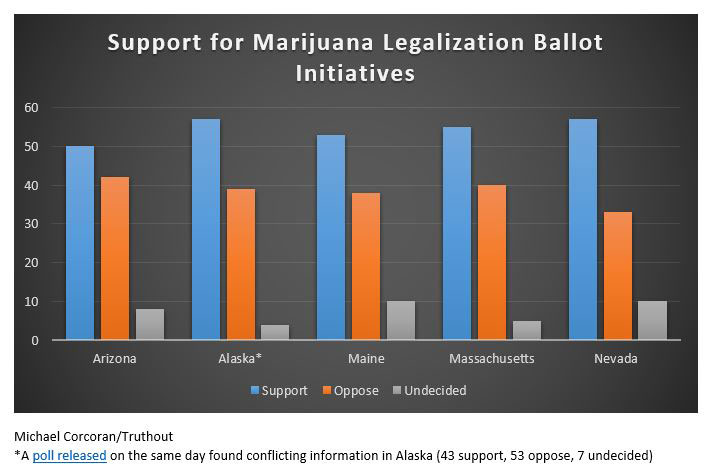
Polling on legalizing marijuana has shown strong support for legalization in Arizona (poll done by Arizona Republic/Morrison/Conkite), Alaska (Ivan Moore), Maine (Portland Press Herald), Massachusetts (WBUR) and Nevada (Suffolk University). *A poll released on the same day (Dittman Research) found conflicting information in Alaska (43 support, 53 oppose, 7 undecided). (Credit: Michael Corcoran / Truthout)

Polling on legalizing marijuana has shown strong support for legalization in Arizona (poll done by Arizona Republic/Morrison/Conkite), Alaska (Ivan Moore), Maine (Portland Press Herald), Massachusetts (WBUR) and Nevada (Suffolk University). *A poll released on the same day (Dittman Research) found conflicting information in Alaska (43 support, 53 oppose, 7 undecided). (Credit: Michael Corcoran / Truthout)

California to Colorado: 20 Years of Progress

Should any of these ballot initiatives pass, they will be the latest in a 20-year run of progressive reforms on this issue. The first major victory was in 1996 when California voters passed Proposition 215, legalizing marijuana for medical use for the first time. Since then 24 more states and Washington, DC, have passed similar laws.

Medical marijuana was a stepping stone to other reforms. And in time 20 states decriminalized non-medical cannabis, making possession of small amounts punishable only as a civil offense — like a parking ticket. These changes proved to be very effective, according to the Center on Juvenile and Criminal Justice (CJCJ).

“As a result [of decriminalization], many fewer young people in the former states are suffering the damages and costs of criminal arrest, prosecution, incarceration, fines, loss of federal aid, and other punishments,” concluded CJCJ’s 2015 study on five states that decriminalized cannabis. “Meanwhile, no harmful consequences appear to be materializing.”

The report, however, concluded that “staggering racial disparities” did not improve even after decriminalization. While decriminalization greatly reduced arrests for marijuana, it did not abolish them; arrests still occur depending on the weight possessed and how the marijuana is packaged, among several other factors. “One particularly striking finding is that post-reform marijuana arrest rates for African Americans across these [decriminalization] states remain considerably higher (251.9) than pre-reform rates for people of all other races (167.7),” the reportconcluded.

The report, in light of these lingering issues, suggested the states “move toward full legalization.” And, as the 2012 election showed, legalization is where the movement is headed.

“The Sky Hasn’t Fallen”: Two Case Studies in Legalization

The legalization of marijuana in the states of Colorado and Washington was obviously a watershed moment for the movement to end prohibition. But more than that, these first states also functioned as valuable case studies showing the potential impacts of legalization. The results have debunked the doomsday scenarios predicted by the opposition.

“I would say that the rollout was extremely smooth: the sky hasn’t fallen like some had predicted, and we’re moving forward and trying to fine-tune this regulatory model,” said Ron Kammerzell, the director of enforcement at the Colorado Department of Revenue, in an interview with Vox. This quote is proudly shared byadvocates of yes votes in states where legalization is on the 2016 ballot.

As the Marijuana Policy Project reported in a July 2016 study, marijuana cases in Colorado plummeted 77 percent, eliminating a lot of wasted time and money. Meanwhile, the industry created almost 30,000 jobs, especially since retail saleslocations opened in 2014 and tourism boomed. In 2015 Forbes named Denver as the best city in America for “business and careers.”

Furthermore, while many opponents of legalization have argued that it would increase drug use among children, trends suggest otherwise. A 2016 study from theWashington School of Medicine has concluded that “rates of marijuana use by young people are falling despite the fact more U.S. states are legalizing or decriminalizing marijuana use and the number of adults using the drug has increased.”

What is arguably most inviting to voters is the tax revenue that has been collected. The Tax Foundation reported in 2016 that “Marijuana tax collections in Colorado and Washington have exceeded initial estimates.” Colorado collected over $135 million in fees and taxes from marijuana businesses, including $35 million that was earmarked for school construction. Washington State, likewise, is expected to collect$270 million annually in revenue from taxes on marijuana. Given that these laws were passed in the aftermath of the Great Recession when states suffered from depleted tax bases and huge budget shortfalls, this added revenue is especially important.

Marijuana and the Political Establishment

While marijuana advocates are thrilled about recent developments, it is worth noting that these citizens are winning despite a political and media establishment that is “way behind the public on this issue,” as Fox told Truthout. “Many politicians are still afraid of being considered ‘soft on drugs,'” he said.

In Massachusetts, for instance, the most powerful politicians in both major parties oppose the referendum, including the governor and the mayor of Boston. In Florida, which must meet a 60 percent threshold to pass the medical marijuana ballot initiative, the National Organization for the Reform of Marijuana Laws (NORML) just filed a lawsuit against a county election supervisor for allegedly leaving the medical marijuana question off the ballots in Broward country.

On the federal level marijuana is still illegal, with the White House’s website devoting a sizable section to express opposition to legalization. It is worth noting, however, that the presidential candidates are more open to reforming marijuana laws than many politicians on the state level. The Marijuana Policy Project grades each candidate for president, and gave Hillary Clinton a B+ for saying that reforms in the states for both medical marijuana and recreational use “need to be supported.” Trump has given conflicting statements and received a C+. Both Jill Stein and Gary Johnson have As.

The Return of “Reefer Madness”?

The 80th anniversary of the Marijuana Tax Act of 1937, the first law to prohibit marijuana in the United States, will come in October 2017. The law was passed after Henry J. Anslinger’s absurd and openly racist campaign, “Reefer Madness,” which alleged marijuana was a “burning weed with roots in hell,” that could cause one tokill their own family members.

The campaign was so bizarre — and unintentionally hilarious — that the Reefer Madness film has a cult following. Yet, in 2016 one can still watch prime-time cable news and hear almost identical ruminations. In 2014 Nancy Grace famously said“people on pot” “shoot,” “kill” and “strangle” each other, and even “kill whole families.” This kind of language is almost identical to the absurdities expressed in the Anslinger days.

Of course, Grace does represent the extremes. CNN’s Sanjay Gupta, for example,reversed his past opposition to medical marijuana in 2013 and now calls for a “medical marijuana revolution.” Still, even “serious” commentators, like The New York Times’ David Brooks, argue that states that legalize marijuana are “nurturing a moral ecology in which it is a bit harder to be the sort of person most of us want to be.” And Brooks, like so many other opponents of legalizing marijuana, does so without even trying to reconcile opposition to a drug that is non-fatal and relatively benign, with his acceptance of legal alcohol, which is potentially fatal and far more dangerous.

Despite Marijuana Reform, Drug War Rages On

Whatever the trajectory of marijuana laws, it cannot be forgotten that it is just one sliver of a much larger injustice: the country’s failed “War on Drugs.” This war rages on — with complicity from the Obama White House — at a steep price to our country, and especially to people of color, who face institutionalized racism at every level of the criminal justice system. Every year well over a million Americans are arrested for drug offenses, often resulting in life-long consequences, including, in many states,losing the right to vote.

“Any changes in the war on drugs will require continued organizing and agitation, because history has shown that one step forward has also resulted in two steps back [for] communities of color,” David Simon, creator of HBO’s “The Wire,” told In These Times in 2013. “Changing the laws in two states, while a step forward, does not cut off the legs of this broader system.”

But since then, Oregon and Washington, DC have legalized marijuana. The 2016 election offers the chance for voters to take the biggest step toward ending marijuana prohibition in the nation’s history. It is possible that by 2017, eight states (plus DC) could be added to the list. And the momentum seems likely to continue into the future. Efforts for more ballot questions in 2018 are already under way.


Copyright, Truthout.org. Reprinted with permission

Follow by Email
Facebook
Facebook
Twitter

Alaska opens up!

Follow by Email
Facebook
Facebook
Twitter

Alaska made history and opened it’s very first legal Cannabis shop today!

Alaska’s first marijuana retailer opens to throngs of customers

By Yvette C. Hammett

VALDEZ, Alaska, Oct. 30 (UPI) — They weren’t giving away marijuana, but that didn’t stop dozens from lining up hours in advance for the opening of Alaska’s first pot shop on Saturday.

Residents of Valdez are calling their community “the highest little town at sea level,” KTVA reported.

People in Alaska see the opening of Herbal Outfitters as a historic event in their state.

Mike Holcombe was chosen to be the first inside the shop, and called the moment “monumental.”

“I didn’t think it would happen in my lifetime that it would be legalized,” Holcombe said of his opportunity to purchase marijuana legally. “I’ve been waiting 46 years for pot to be legal.”

It was worth the wait, said those who braved the chill and drizzling rain to encircle the store’s entrance.

“We wanted to be part of the crowd that bought the first legal weed in Alaska,” Christopher Front told The Alaska Journal. He traveled from Anchorage with his wife Hannah and dog, Daisy.

“She wanted to be the first dog,” he added.

Herbal Outfitter manager Derek Morris said he was as surprised as anyone to learn the first shop would open in Valdez instead of in Anchorage or Fairbanks.

“We never anticipated that we’d be the first legal sale,” Morris said. “That’s still a little bit of a shock to us.”

Valdez’s previous claim to fame was as the site of the infamous Exxon Valdez oil spill. That spill funneled federal disaster relief funding into Alaska when it was undergoing an oil-driven economic recession, similar to the one Alaska has now, only worse.

Now, it is part of an industry raking in hundreds of millions of dollars in Colorado, Oregon and Washington.


Source: http://www.upi.com/Top_News/US/2016/10/30/Alaskas-first-marijuana-retailer-opens-to-throngs-of-customers/2301477854270/

Follow by Email
Facebook
Facebook
Twitter

Drug Policy Action Congressional Voter Guide

Follow by Email
Facebook
Facebook
Twitter
During this pivotal election year, which representatives are on the right side of drug policy history? It’s time to see your elected official’s record.

Select this link and enter your zip code to see your if representative is fighting to end the drug war.

Follow by Email
Facebook
Facebook
Twitter

Support for Legal Marijuana Use Up to 60% in U.S.

Follow by Email
Facebook
Facebook
Twitter

by Art Swift

STORY HIGHLIGHTS

  • Highest percentage of support recorded in 47-year trend
  • Favoring legalization is up among all age groups in the past decade
  • Large majorities of Democrats, independents favor legalization

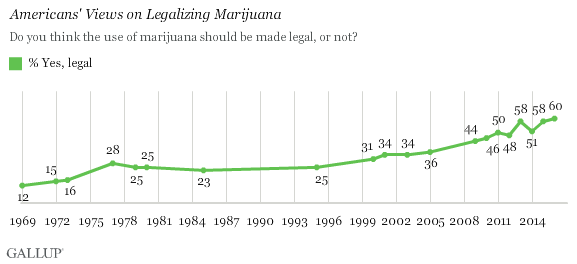
WASHINGTON, D.C. — With voters in several states deciding this fall whether to legalize the use of marijuana, public support for making it legal has reached 60% — its highest level in Gallup’s 47-year trend.

Americans' Views on Legalizing Marijuana

Marijuana use is currently legal in four states and the District of Columbia, and legalization measures are on the ballot in five more — California, Arizona, Massachusetts, Maine and Nevada — this November. As a result, the percentage of Americans living in states where pot use is legal could rise from the current 5% to as much as 25% if all of these ballot measures pass.

When Gallup first asked this question in 1969, 12% of Americans supported the legalization of marijuana use. In the late 1970s, support rose to 28% but began to retreat in the 1980s during the era of the “Just Say No” to drugs campaign. Support stayed in the 25% range through 1995, but increased to 31% in 2000 and has continued climbing since then.

In 2013, support for legalization reached a majority for the first time after Washington and Colorado became the first states to legalize the recreational use of marijuana. Since then, a majority of Americans have continued to say they think the use of marijuana should be made legal.

Today’s 60% is statistically similar to the previous high of 58% reached in 2013 and 2015, so it is unclear whether support has stabilized or is continuing to inch higher.

Support Up From a Decade Ago Among All Age Groups

Support for legalizing marijuana use has increased among most subgroups in the past decade, but more so among certain groups than others. For example, support is up 33 percentage points to 77% among adults aged 18 to 34, while it is up 16 points among adults aged 55 and older to 45%.

Support for the Legalization of Marijuana, by Age Group
2003 and 2005 2016
% %
National adults 35 60
18-34 44 77
35-54 35 61
55+ 29 45
Note: Analysis combines data from 2003 and 2005 because each survey asked the question of a half-sample of respondents
GALLUP

Democrats and Independents Soar to Majorities Favoring Legalization

Additionally, support is up more among independents and Democrats than it is among Republicans, partly because of the older age skew of the last group. Seventy percent of independents and 67% of Democrats support legal pot use, a major increase since the combined survey of 2003 and 2005 when 46% of independents and 38% of Democrats supported the idea. While less than a majority of members in any political party backed legalizing marijuana in 2003 and 2005, Democrats and independents have fueled the recent nationwide surge in support.

Support for the Legalization of Marijuana, by Political Party
2003 and 2005 2016
% %
National adults 35 60
Republicans 20 42
Independents 46 70
Democrats 38 67
Note: Analysis combines data from 2003 and 2005 because each survey asked the question of a half-sample of respondents
GALLUP

Republicans’ support has doubled from more than a decade ago, yet only 42% of GOP members now support legal marijuana use.

Bottom Line

If recreational marijuana use becomes legal in California this year, many other states will likely follow, because the “Golden State” often sets political trends for the rest of the U.S. As more states legalize marijuana, the question of whether the drug should be legal may become when it will be legal. The transformation in public attitudes about marijuana over the past half-century has mirrored the liberalization of public attitudes about gay rights and the same-sex-marriage movement, the latter of which the U.S. Supreme Court deemed legal last year. It is possible that it might take a Supreme Court case to settle this matter, too.

Historical data are available in Gallup Analytics.

Survey Methods

Results for this Gallup poll are based on telephone interviews conducted Oct. 5-9, 2016, with a random sample of 1,017 adults, aged 18 and older, living in all 50 U.S. states and the District of Columbia. For results based on the total sample of national adults, the margin of sampling error is ±4 percentage points at the 95% confidence level. All reported margins of sampling error include computed design effects for weighting.

Each sample of national adults includes a minimum quota of 60% cellphone respondents and 40% landline respondents, with additional minimum quotas by time zone within region. Landline and cellular telephone numbers are selected using random-digit-dial methods.

View survey methodology, complete question responses and trends.

Learn more about how the Gallup Poll Social Series works.


Source: Gallup

Follow by Email
Facebook
Facebook
Twitter

So Far, So Good: What We Know About Marijuana Legalization in Colorado, Washington, Alaska, Oregon and Washington, D.C.

Follow by Email
Facebook
Facebook
Twitter

In 2012, Colorado and Washington became the first two U.S. states – and the first two jurisdictions in the world – to approve ending marijuana prohibition and legally regulating marijuana production, distribution and sales. In the 2014 election, Alaska and Oregon followed suit, while Washington D.C. passed a more limited measure that legalized possession and home cultivation of marijuana (but did not address its taxation and sale due to D.C. law).

The report’s key findings include:

  • Marijuana arrests have plummeted in the states that legalized marijuana, although disproportionate enforcement of marijuana crimes against black people continues.
  • Statewide surveys of youth in Colorado, Washington, Alaska, and Oregon found that there were no significant increases in youth marijuana use post-legalization.
  • Tax revenues in Colorado, Washington, and Oregon have all exceeded initial revenue estimates, totaling $552 million.
  • Legalization has not led to more dangerous road conditions, as traffic fatality rates have remained stable in Colorado, Washington, Alaska, and Oregon.

Read the report here.


Follow by Email
Facebook
Facebook
Twitter